Pages

  • Twitter
  • Facebook
  • Google+
  • RSS Feed

Sunday, September 15, 2013

Photo from Daily Grind House
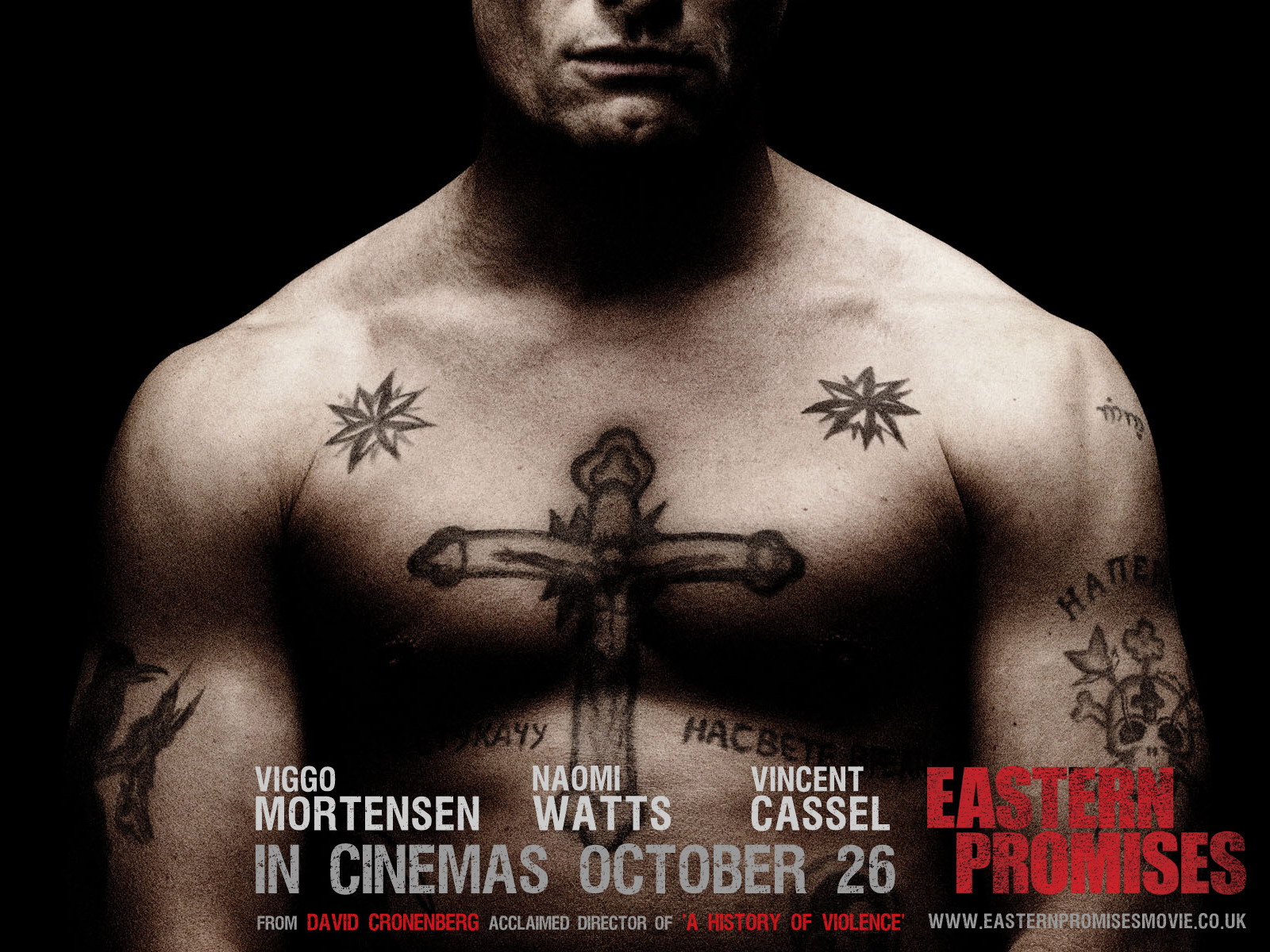
There is beauty in watching films of which you have no idea what it is about, what is going to happen, who are the actors and who directed it. The kind of film that was presented to you in surprise. The element of surprise will always be present. The same thing happened when I saw David Cronenberg's Eastern Promises. Eastern Promises was indeed a surprise. For an audience who did not know what to expect from the film, the opening scene of Eastern Promises was a shocker. That throat slashing scene is totally unexpected.You know the opening scene is good when you instantly catch the audience's attention, including the unwilling ones. Eastern Promises' effect is just like that.

As the story progresses, it keeps on getting interesting at the same time, questions arose. Then, a young girl bled as she collapsed. The girl was brought to the hospital where the midwife, Anna (Naomi Watts)
photo from Fiancee Bodas
, found her diary inside her bag. Unfortunately, the girl died, leaving her child alone. Next day, Anna's 
Russian uncle, Stepan (Jerzy Skolimowski), was reading the diary. We get to know that the girl is named Tatiana. Uncle Stepan told Anna to bury the diary, her secrets, together with Tatiana's remains. But Anna is determined to find Tatiana's family so that the baby will not go on fostering program. Anna found Trans-Siberian's calling card in the diary. Thinking this will lead to finding Tatiana's family, she went to the restaurant. At this point, Cronenberg established the importance of the diary in the story.
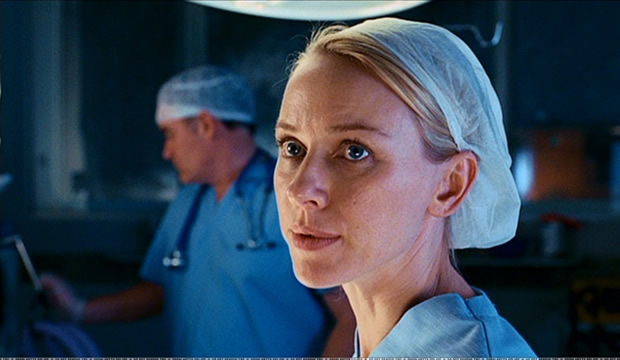
Photo from Post-Punk Cinema Club
When Anna arrived at the restaurant, we see two gangster-looking men, Nikolai (Viggo Mortensen) and Kirill (Vincent Cassel). At this point I was sure they are the bad guys. When Anna rang the door bell, an old man, Semyon (Armin Mueller-Stahl), open the door. He let her in, showed her around and was incredibly nice to Ana. Semyon, I thought, is the one going to help Anna.

There were occasional sleepy stretches all throughout the film, maybe because of the lack of music, but still Eastern Promises is one surprising film. 
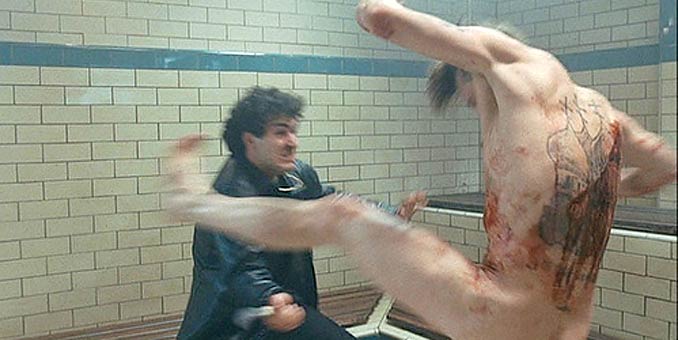
photo from Pop Babble
Probably the best scene from this film is the fighting scene between Nikolai and the Chechens. Tuns out Semyon set up Nikolai as Kirill so the Chechens will mistaken Nikolai as Kirill. The scene was set in a public bath, Nikolai fought naked with no weapons. This scene is undeniably violent. The use of knives instead of guns made the scene more violent. Two dressed men armed with knives, versus a naked man without any weapon, this shows how Nikolai is so inferior of the two Chechens. I could not remember how many times I looked away because I could not take it anymore. This scene is so intense our whole class was going crazy and screaming at the top of our lungs while watching this scene. The  most brutal, gruesome, painful and intense scene I have watched to date.

But what I liked the most from Eastern Promises is its major plot turn. At first who I thought the bad guys turns out actually the good one, and the good guy is actually the bad one. It was revealed that Nikolai is not a mafia or a chauffeur, he is actually an agent of the KGB, a Russian government security agency, who penetrated the Russian Mafia organization in London. I love how at first I thought he is dangerous, and mysterious when he started to help Anna, only to reveal he is an ally of the good.

photo from New York Times 

I recommend Eastern Promises to people who love crime films. This is a crime film that actually has a story. A god story.   

Watch the trailer here:


Tuesday, September 3, 2013

Then

Paramount Pictures
photo from American Cinema
During the period of 1930s to the late 1960s in Hollywood, the studio system controlled everything from the directors, writers, stars, equipment, filming and the likes. All of the people who worked for the studios lived under one roof in acres of lot owned by the studio. All of them were under an exclusive contract with the studio. This means they cannot work for another studios. Studios acres of lot where they also shot films they made. From the pre-production stage, down to the distribution, and even the promotion of films, everything was controlled by the studio. They distributed films they made only to the movie houses they owned. For example, MGM then owned thousand of studios,and they would only distribute their films in movie houses they owned.


Marilyn Monroe
photo from Wikipedia
In the Star System, actors were being taken care of as if they were gems. The Star System honed these actors into superstars. They prepared them for super stardom by giving them thorough training for dancing, singing, acting and the likes. The Star System created almost perfect being from then normal people. These actors were being owned by the studios they were under contract with. Actors were usually under contact with studios for five to seven years. They were expected to be perfect all the time; no negative images and dirty acts, that's why these kinds of things happened without the people knowing.


Now

In the present time, it seems that The Studio System and The Star System then, is the total opposite of what we have today.

Studios are still there, but the studio system is already gone. The studios no longer monopolize all the works in the film industry. The directors no longer work for a studio system alone. Directors now can work with whatever studio they like to work with, or they can work on their own. The studios no longer distribute films in their owned movie houses; films are being distributed anywhere. They no longer film in studio acres alone, they film outside. The stars no longer work under a particular studio alone; actors can now work anywhere they please. And negative images and dirty acts are no longer being covered.   


-----


Source:
Jenkins, S. (Director). (1995). The Star [documentary episode]. In American Cinema- 100 Years of Filmmaking. Arlington: PBS.

Sunday, September 1, 2013

No words were uttered, yet, Un Chien Andalou is one of the most powerful, shocking, and confusing films I have ever seen. 

The film opened with a man, portrayed by its director, Luis Buñel, sharpening a razor, then tests the razor in his own thumb. It seems that this prologue prepares us for what is yet to come. Un Chien Andalou, is a film that has no plot and jumps into one scene from the other. A classic example of a Surrelist film, Un Chien Andalou is irrational, unconventional, and undoubtedly weird.

eyeball slitting scene from Un Chien Andalou
The film continued with Luis Bunuel going to his balcony then stares at the moon and clouds. He then slid his razor through the Woman's eyeball, and weird enough, the woman seemingly accepts what was happening. We are yet only in the first part of the film, but, Un Chien Andalou already shocked the audience. The story is just about to unfold, but it seems like Luis Bunuel already brought us to the climax. 

Because of my knowledge that this scene is about to come, I braved myself and kept my eyes open while this scene is playing. I don't know if it was a good decision, but it my second time watching this film, I skipped this part. One is enough for me.

still from Wikipedia
In the next scene, we see  a Man wearing a nun's habit, with a box with diagonal designs that he was wearing around his neck. The Woman I saw earlier is alive sitting in a room. It seemed that she was anticipating for the Man to come. She looked at the window and saw the man collapsed on the ground. She rushed to him and kissed him all over his face. We were brought back to the Woman's room with the Man's clothes placed on the bed. The Woman opened the box with diagonal designs and got the necktie out of the box the put it together with the other clothes. She sat and stared at the bed. The necktie moved on its own tying itself to the polo. We then see the guy who was wearing a nun's habit earlier, now wearing coat and tie, standing inside the room. He was deeply staring at his hand. His hand was focused and there were ants coming out of his hand. 

The next scene is at the road down the room with a lady moving a cut hand with a stick. She was surrounded with people trying to know what was happening, while there are policemen trying to stop them from interfering. One police took the hand and put it inside the box with the diagonal designs. How did the lady get the box? She hugged the box and stood in the middle of the road. The people and policemen left her. We then see the Man and the Woman watching what was happening. The Man was watching the lady and it seems that he was anticipating for a car to hit the lady. And true enough, the lady was hit by a car.

Then the scene was back to the room. The Man assaulted the Woman. He wants to get her on bed but she fought back. He felt her breasts but the Woman was stopping him. But a little later, she allowed him to. The Man started imagining himself touching the Woman's breasts with no clothes on. His eyes were up, seemed like he was having a high fever or something, while blood is dripping from his mouth. Do you really bleed while having so much pleasure?  Then back to reality, the Woman stopped him, she ran to one corner, took something that what looking like a tennis racket and was ready hit him. The Man stepped back and started pulling two grand pianos, with animals that looked liked donkeys, that seems to be rotting and their eyeballs missing and with blood on their eye sockets, atop of the piano. Plus two priest tied together. The Woman got to escape on the door near her, and she caught the Man's hand on the door. The hand that was caught was the hand with ants coming out of it.

still from Wikipedia
In the next scene we see the guy back in a nun's habit lying on the bed. Then a guy came, dragged him out of the bed, took off the nun's habit and threw it all out of the room. He made the Man faced the wall with his hands up. The guy's face was not being shown. Who is he? When the guy's face was shown, he looked exactly like the Man. The guy gave the Man books to hold on to. When the guy was about to exit the room, the Man faced him, the books turned into guns. The Man shot him. The setting changed and the man fell in an outdoor place. He hold on to a lady's naked back before he totally fell on the grass. The woman faded away, then a group of men found him lying on the grass field. Then  two men walking was shown. One men from the group sought help from the two men. They seemed not to entertain him, then on the next scene we see the two men together with the group, the the men bought the man and took him away. 

still from Wikipedia
The next scene is back to the Woman. In the room, she was staring at a butterfly. The Man was there, he covered his mouth, when he removed his hand, his mouth was gone. The Woman started to put lipstick on. The Man's gone mouth became black and the Woman put out her tongue to tease him. He went out of the door and we were brought into a beachfront. Where wee see her lover waiting for her. Was this all a dream? But while walking by the sea, they saw the box with diagonal designs at the shore. It was drifted by the water towards the shore. The couple continued to walk. The end.

When the scene of the Man came, in my mind I was thinking that this is the start where something about the eyeball slitting would make sense of. But rather than my question being answered, as the story progresses, I just added more questions to my list. I kept faith that it will all make sense at the end of it all. I've waited until the end, yet all I've got were questions and no answers. None at all. And the end of the movie, I was like "What the hell happened? Someone explain this to me." I am trying to process in my mind what it is all about. Are they symbolism? If they are, what do they symbolize? Are they dreams put together? Dreams that have deep meanings? And my question that certainly needs to be answered, what is the message of the film? I think it is the first film that I have watched that I understood almost nothing at all. I will not pretend to be intellectual and analytic, I did not get it. This surrealist film is indeed surreal. 

I may need to read more about the film, surrealism, Luis Bunuel, Salvador Dali and other things from this film to be able to decode it, to be able to make sense of it.

My mind is really trying its best to give a coherent explanation about this, but this is the only answer that satisfied my need of explanation:

“When everything gets answered, it's fake.” 
― Sean Penn


People always seek answers to questions. We want explanation of things we do not understand. If we get no answers, we try to make our own explanation of things. We always want validation. We want concreteness, security, assurance. Maybe what Un Chien Andalou is trying to tell us is that you don't always need answers  to everything, that science not applicable to everything. You have to accept that there are really things that are existing with no answers why they are existing; or why something happens out of the blue. The are unanswered questions, and let them be. And why? Because mystery adds beauty to life.

You may watch the film here and please do share your thoughts below!


Thursday, August 29, 2013

How long can you go to satisfy your pleasure?

photo from Geek Scoop

photo from Tumblr via Late Comers
       From cooking up, to injecting the chemical into their veins, and even the cleansing of body,  I don’t think I have ever seen a movie about drugs this detailed.  Set in Edinburgh, the story happens in Mark Renton’s (Ewan McGregor) point-of-view. Though this film has a lot of voice over/ narration by Renton, it did not make the film boring because we still see the story unfolds through characters’ actions. The narrative style of the film even gives us access to what Renton thinks about.
I always thought drugs are disgusting, I probably would not be able to handle seeing someone do drugs in front of me, but this film did not wrap the whole heroin thing as too disgusting for people to see, but makes it bearable for people to see. At least on the heroin thing level, because the bed sheet filled with faeces scene is just too disgusting in my honest opinion. I am, in fact, still in the process of making sense why it has to be included, I get it, on the surface level, it is for comedic purposes, but beyond that, I question what its relevance to the story is.
The toilet scene
photo from Fancy Dress Costumes
Same goes with the toilet scene; it is just way too disgusting for me to watch. But in this scene, at least, I get the point that it is a fantasy scene, and it is not happening in reality. And I believe this scene symbolizes Renton going through the process of catharsis. But then again, I still think it is too disgusting. I believe that the toilet scene also symbolizes that there is beauty in ugliness. Thus, these these things made up for the filthiness of the scene.  Watch the toilet scene here. 

The hallucination scene of Renton where he was locked up in his room is well done. It is bizarre and terrifying. This particular scene has continuity thus able depicting hallucination accurately. I like how they made being high, or trying to get away from heroin, though all unpleasant, yet were artistically done. 


Renton's hallucinatrion scene
photos from The Cue Dot Confessions
This film is beautifully written. The style of storytelling is beautiful. The dialogues are not to be taken for granted. The things they say are very quotable and rings true to emotions. The “choose life” monologue of Renton is an example. It is brilliant and smart.

"Choose Life. Choose a job. Choose a career. Choose a family. Choose a fucking big television, choose washing machines, cars, compact disc players and electrical tin openers. Choose good health, low cholesterol, and dental insurance. Choose fixed interest mortgage repayments. Choose a starter home. Choose your friends. Choose leisurewear and matching luggage. Choose a three-piece suit on hire purchase in a range of fucking fabrics. Choose DIY and wondering who the fuck you are on Sunday morning. Choose sitting on that couch watching mind-numbing, spirit-crushing game shows, stuffing fucking junk food into your mouth. Choose rotting away at the end of it all, pissing your last in a miserable home, nothing more than an embarrassment to the selfish, fucked up brats you spawned to replace yourselves. Choose your future. Choose life... But why would I want to do a thing like that? I chose not to choose life. I chose somethin' else. And the reasons? There are no reasons. Who needs reasons when you've got heroin?"

Watch it here:


Scenes were shot incredibly. The scene where Renton sinks in the floor is very unique. Of course the opening scene which consists of dolly shots should not be forgotten. The whole film is beautifully shot it even led me to think that this film was made just a couple of years ago, until I saw the VHS tapes in the film. The scene where Renton is lying in the street, the great outdoors scene, Tommy asking Renton for heroin scene, are also some of the scene that  were beautifully shot.

Each character in the story has different traits. We get a glimpse of who they are when Renton hits a car and the rest of the gang when they were playing football. Each of them added colour and created conflict in the story.
The boys. L-R Spud, Tommy, Begbie, Renton, Sick Boy

Trainspotting deals about the issue of youths being involved in drug addiction. It tells about what happens to these lives because of addiction. Trainspotting serves as a warning tool to not do drugs. It also tells us that Renton he hates being Scottish which I think a message the film wants to send to us that this is how Scottish people feels during that time. It also revealed the brutality in the society and I-am-better-than-you mentality, through Begbie, the neglect of people with important things through Baby Dawn’s death and how people, even the one your “so-called mates”, can treat you like dirt.

The main cast
photo from Pinterest 

Trainspotting tells a story with no intention to deceive its audience. A story of youths dealing with drugs, is realistic and brutally honest. It went into details about drugs. How to use it, the pleasure of it, ways how to stop the addiction, the desperate actions just to get money to buy drugs, but Trainspotting does not glorify it. Thus, makes people realize why we should not try it, because Trainspotting also tells us the misery and horrible lives of drug-dependents. Trainspotting tells us how much of life these drug-dependents miss because of heroin. Drugs take away a lot from you. Your life, your soul, your love. The death of Baby Dawn implies that we only realize the importance of one thing until it’s gone. Drugs can take away the most important part of you. Trainspotting wants us to think that everyone can love and be loved no matter miserable you are. And probably the best lesson this film teaches us is that you are not a hopeless case. Even if you are the lowest of the low, there is a room for change, as long as you have the willingness to change. If the failed on the first try, there is always a second one, third, fourth and so on. Just don’t stop trying. You can beat drugs. You can. Choose life. And if in your life you came across drugs, teach yourself to just say no.

photo form Pinterest 

Wednesday, August 28, 2013

German films were very few during the start of the World War I. German film industry was being dominated by foreign films such as French, American, Italian and Danish films. America and France banned German films, but the German film industry could not do the same to the American and French films because there will be scarce in films.

To fight these domination of foreign films, the government started to support the film industry, thus signaled the birth of German Expressionism. UFA (Universum Film Aktiengesellschaft) was established in 1917 to promote pro-war films. 

After the militarist propaganda appeared, German films focused on three genres: adventure serial, featuring spy rings, clever detectives or exotic settings. 

Despite negative judgement of America, England and France against German films, these films were able to break into the international market. Ernst Lubitsch's Madame Dubarry helped to reopen the world film market industry to Germany. In 123, Lubitsch became the first German director to be hired in Hollywood. 

As the girl leans, she blends with the curve t\at the background.
still from Genuine. Photo from Silent Era.com
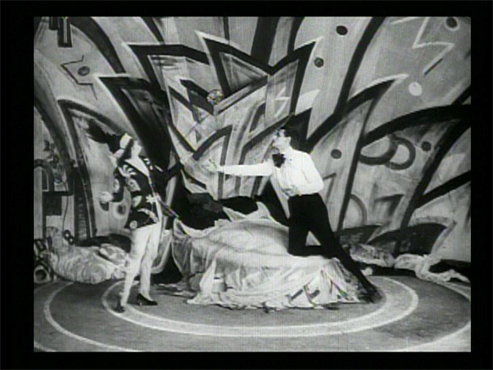
German Expressionism is a highly stylized artistic movement that gives more emphasis on emotions rather than realism. German expressionism relies heavily on mise-en-scene. Set designs are highly elaborated and creative. There is a sharp contrast between lights and shadows. Characters merge within the setting. In German Expressionist film, nothing seem to be real, characters make up their own word. 

One of the first films of the movement, The Cabinet of Dr. Caligari, the classic example of the movement, became the very definition of a German Expressionism film.  The Cabinet of Dr. Caligari is about a traveling magician with a hypnotized servant who does his master's murderous bidding under the cover of the night. (Kolar, n.d.) This film used spiky shapes, over the top make ups, creative and unrealistic two dimensional set designs. Dr. Caligari is bizarre, unusual and horrific; perfectly defines what German Expressionism is.

still from The Cabinet of Dr. Caligari
photo from Mubi.
From 1919 to 1926, German Expressionism is a short lived movement. Because of the popularity of German Expressionism, a lot of personnel were lured to go to Hollywood. Some stayed, but when the Nazi regime gained complete control over the nation, they all left and went to Hollywood. Even if German Expressionism already ended in the country where it started, German Expressionism continued to flourish in Hollywood. And even up to this day, German Expressionism is still present in the world of films. 


-----


Sources:
Bordwell, D. & Thompson, K. (2008) German Expressionism (1919 - 1926) In Film Art: An Introduction (8th ed., pp. 4470-450) New York: McGraw-Hill

Kolar (n.d.) German Expressionism: The World of Light and Shadow [Web log post] Retrieved from http://mubi.com/lists/german-expressionism-the-world-of-light-and-shadow
 
© 2012. Design by Main-Blogger - Blogger Template and Blogging Stuff